Community Friends,
Here we are in Earth Month, with Earth Day, April 22nd; however, as we say: "Earth Day is every day".
April is also Native Plant Appreciation Month, both nationally and in Washington state. National Arbor Day is Friday, April 24, 2026. Based on the best tree planting times, many states and/or cities observe Arbor Day at a different time, which is why Kirkland typically celebrates Arbor Day in fall. The timing is in anticipation of the rainy season to provide necessary water for roots to establish.
April's Earth-related celebrations are a timely reminder that we are all on this globe together and we each make an impact. It is possible to bring back the wild to our urban landscapes because nature is remarkably resilient when given the chance.
April is a good time to add native species to your yard/garden/balcony and get it certified! Certify in April to get 20% OFF your certification fee and any Certified Wildlife Habitat sign using the code GARDEN20.
If you haven't already, sign up for Kirkland Conserves, and consider volunteering to help care for local forests and natural areas with the Green Kirkland Partnership.
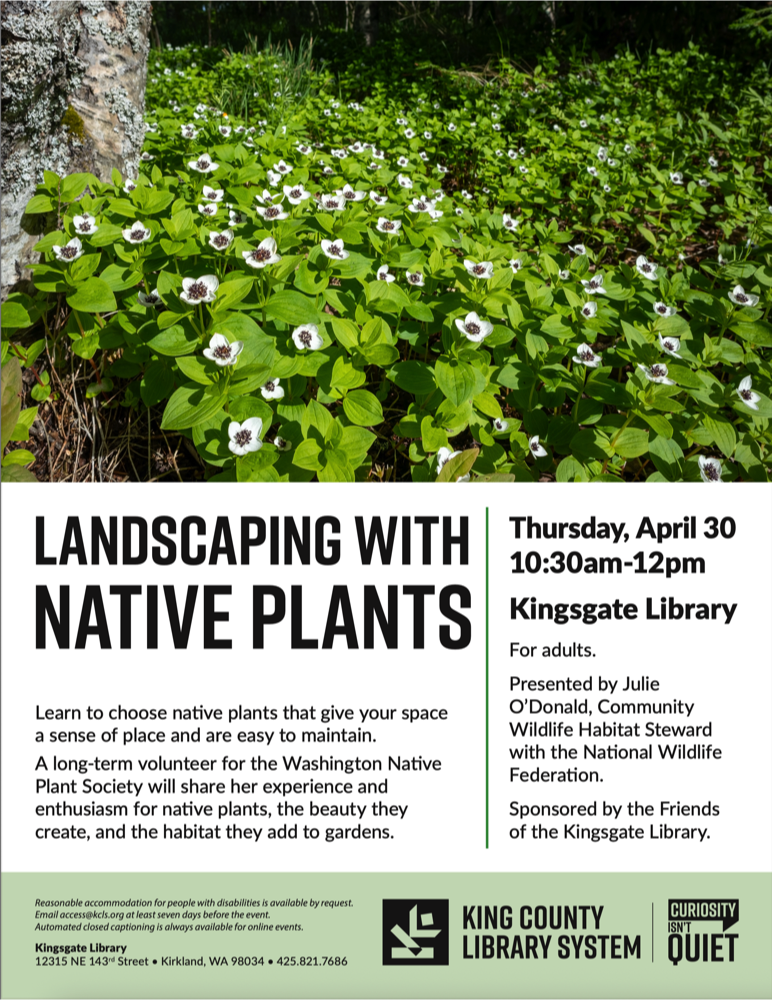
Kirkland Habitat's primary Earth Month activity is our support of a presentation on Landscaping with Native Plants. It's a good opportunity to connect with like-minded people who value the benefits of native habitat.
Date & Time: Thursday April 30th 10:30am-12:00pm
Location: Kingsgate Library, 12315 NE 143rd Street, Kirkland WA 98034
Presenter: Julie O'Donald. Master Gardener, Community Wildlife Habitat Steward with the National Wildlife Federation, and a long-term volunteer for the Washington Native Plant Society.
Julie O'Donald has turned her yard into a certified wildlife habitat, with over 200 species of native plants that attract birds, butterflies, and beneficial insects. She will share her experience and enthusiasm for native plants, the beauty they create, and the habitat they add, no matter the size of your yard or balcony. Her garden has been featured in Pacific Horticulture, The Butterfly Gardener, Bird Watching Magazine, and Sunset publications.
Sponsored by the Friends of the Kingsgate Library.
A link to the program is on the library events page. Registration not required.
For questions contact librarian Meredith: (425) 821-7686 or kcls-kingsgate@kcls.org.
Attend the presentation and visit us at our Kirkland Habitat display booth 😊 You might be fortunate enough to receive a potted native plant grown by one of our members!
Efforts to create plantings that welcome wildlife can sometimes have unintended consequences. We can improve protection for the creatures we invite to our properties.
This is the first of four articles on avoiding unintended harm; articles will be continued over the next three quarterly newsletters. The information comes partly with thanks to Sarah F. Jayne for her self-published book, "Nature's Action Guide: How to Support Biodiversity and Your Local Ecosystem." The book provides a comprehensive reference of step-by-step instructions and resource lists to nurture beneficial wildlife.
Start by turning off the outdoor lights.
Like us, many species use the night as a period of rest and recovery; however, what about all the wildlife that come to life at night? Night critters include bats, spiders, and those that are vulnerable to desiccation and predators during the day. Native centipedes, millipedes, snails, slugs, and earthworms all take advantage of the fact that nights are typically more humid and it's harder for predators to see them. Did you know that we have fascinating native snails and slugs that are important for ecological function?
"If you've ever had a neighbor with a light that shines in your window when you're trying to sleep, you know it's really disrupting to your cycle," says Mary Phillips, Head of Native Plant Habitats and Communities at the National Wildlife Federation. "It's the same for wildlife in general but particularly our nocturnal species."
Artificial light at night confuses insects and migrating birds and can cause harm. Light pollution attracts and disorients insects, including night-fliers like moths. They become exhausted as they circle or collide with the light source, contributing to drastic population declines. Most moths, whose caterpillars are a primary food source for baby songbirds, are night-fliers, and are likely heavily impacted.
To help the creatures that are more active at night, we can best reduce harms by:
Closing shades and curtains at night.
Limiting the use of outdoor lighting to essentials only.
Placing fixtures on motion sensors to illuminate only when needed, and fit them with amber or yellow LED bulbs, not white bulbs. Switching from white outdoor lightbulbs reduces harm to many insects. (Note when shopping that lumens, not wattage, is the more accurate gauge of brightness; least bright is best.)
Choosing night fixtures designed to direct light just where it's needed, not upward where it might do extra harm.
Did you know that plants produce melatonin and other hormones similar to those found in humans? Preliminary research shows that plant melatonin, which helps to regulate growth, might be adversely affected by night lights because "Plant life follows a clear melatonin cycle. Night brings a rise in melatonin, while sunlight brings a drop."
Please note that our Native Plant of the Month articles will resume after a few months' break.
From your friendly community supporters,
Kirkland Community Wildlife Habitat Team (Kirkland Habitat)
Sharon Rodman with Aly, Ann, Ash, Marilee, Meredith
Please like or follow us on Facebook
Kirkland's Community Wildlife Habitat Program helps residents create thriving wildlife habitat —and grow a healthier, more vibrant city for people.
We encourage residents to certify their properties to show support for wildlife-friendly activities: https://www.nwf.org/certifiedwildlifehabitat.
Appreciating and enhancing habitat in Kirkland, which is situated on the ancestral, unceded land of the Puget Sound Salish people; we acknowledge and honor the land with gratitude.
If you want to unsubscribe from these newsletters, reply to this message with your request.