Marilee Henry
Autumn is the best season to plant natives. Perennials will have finished flowering/fruiting and can put their resources into establishing deep roots. Fall is also the season for numerous plant sales - see the list at the end of this article for a few that carry mostly native species.
Research shows that about 90% of flowering plants (including food crops)
require insect/animal pollination for propagation. Habitat loss from human developments, climate-change-induced droughts and rising temperatures, and pollution have resulted in alarming declines in pollinator populations. But all of us can help improve this situation by planting native species in our yards, in business property landscaping, or even in containers on apartment balconies. We can also pressure local, county, and state agencies to use native species in their open spaces and restorations. Again, according to recent research, 70% of a region's vegetation at a minimum must be native to support stable insect/bird populations.
So let's start a pollinator garden! Here are a few simple guidelines to keep in mind when designing your plot.
1. Please do not use any herbicides or pesticides. These chemicals always have effects on non-target species. When nature is in balance, pests are usually kept to acceptable levels. Nibbles on leaves could be from larvae that will turn into beautiful butterflies. Mole holes can become winter shelters for bees.
2. Diversity is key. According to the Washington Bee Atlas there are up to
700 species of native bees in our state. Roughly a quarter of that number are specialists, meaning they require specific native plants for survival. Bumble bees are generalists; they can gather nectar and/or pollen from many different plants. A diverse assortment of native species will benefit far more types of pollinators than a single large monoculture of lavender which is a non-native good for generalists only.
3. Plant clumps of each species. Many pollinators practice "flower constancy", visiting the same flower species in succession during a specific
foraging trip rather than randomly visiting any flower in any order. This habit is more efficient for the pollinator and results in better germination rates within the visited species. A good clump of showy fleabane or pearly everlasting contains 3 to 12 plants. In a large area that can include shrubs, try to plant a minimum of 2 large shrubs (ex. Mock Orange) or 3 smaller ones (ex. Alpine Spirea) within easy sight of one another for ease of pollinator visibility. Clumps of perennial flowers and vines can be spaced close together among logs, trellises, or rocks for visual interest while providing soil nutrition and aiding moisture retention. If you have only a small area, go for clumps of a few species that bloom at different times rather than more species of only one plant each.
4. Plant a variety of colors and flower types for early, mid, and late season blooms. For those of you not too familiar with native plants, this might seem daunting. But keep it simple and start with a few easy-to-find easy-to-grow species, adding more in future seasons.
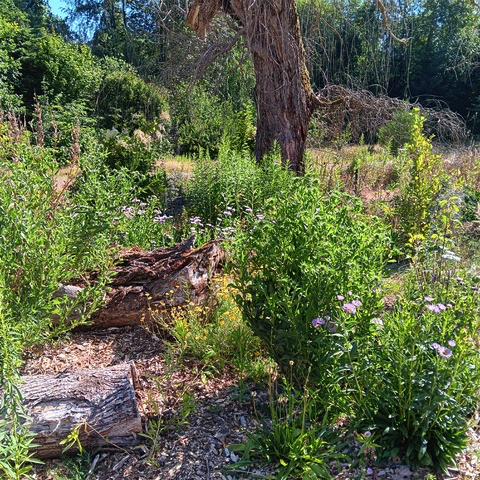
As an example, below is a list of the species I have planted in my restoration site at Juanita Bay Park with their colors and approximate bloom seasons. I have tried to include diverse flower types such as tubular for bumble bees and hummingbirds, to flat-topped clusters for beetles and butterflies. The site is mostly in full sun, has fast-draining sandy soil, and does get some supplemental watering about every two weeks in summer. Planting around logs and mulching with arborist chips helps retain soil moisture. You can see photos of these species on the Burke image collection website. Most of them are available at native plant sales and at native plant nurseries. They are also easily grown from seeds. Sources for seeds and plants can be found here.
Large Shrubs:
Red-flowering currant/early/red (Ribes sangineum)
Tall Oregon grape/early/yellow (Mahonia aquifolium)
Mock orange/early-mid/white (Philadelphus lewisii)
Redstem ceanothus/mid/white (Ceanothus sangineus)
Ocean spray/mid/white (Holodiscus discolor)
Puget Sound Gumweed/late/yellow (Grindelia integrifolia)
Small Shrubs:
Birch-leaved spiraea/mid-late/white (Spiraea lucida)
Vines:
Orange honeysuckle/mid/orange (Lonicera ciliosa)
Groundcovers:
Wild Strawberry/early-mid/white (Fragaria vesca)
Short Perennials (under 2 feet tall):
Early blue violet/early/bluish-purple (Viola adunca)
Yellow monkey-flower/mid/yellow (Erythranthe guttata)
Tall alumroot/mid/cream (Heuchera chlorantha)
Oregon sunshine/mid/yellow (Eriophyllum lanatum)
Cascade penstemon/mid/magenta (Penstemon serrulatus)
Bluebells of Scotland/late/blue (Campanula rotundifolia)
Tall Perennials:
Great Camas/early/blue (Camassia leichtlinii)
Streambank lupine/early-mid/blue (Lupinus rivularis)
Fireweed/mid/magenta (Chamaenerion angustifolium)
California figwort/mid/brownish-purple (Scrophularia californica)
Bigleaf lupine/mid-late/blue (Lupinus polyphyllus)
Showy fleabane/mid-late/purple (Erigeron speciosus)
Pearly everlasting/mid-late/white (Anaphalis margaritacea)
Wild Bergamot/late/lavender (Monarda fistulosa)
Yarrow/late/white (Achillia millefolium)
Goldenrod/late/yellow (Solidago lepida)
5. Nature is a bit messy. Pollinators need your garden to provide shelter as well as pollen, nectar, and larval host plants. In winter, many native bees and other pollinators seek nesting spots underground, in leaf mulch, in hollow flower stems, or in rotting logs. So chuck out pristine gardening habits: leave a patch of bare dirt and rodent holes for burrowing bees, cut spent flower stems no shorter than 18 inches, rake fallen leaves onto your garden beds, and when large trees must be removed, whenever possible leave a portion of the trunk standing for insects, woodpeckers, and nesting birds.
6. Go native! Some non-native plants such as lavender, sage, rosemary, and oregano, attract large numbers of honeybees, bumble bees, and other generalist pollinators and can make beautiful additions to a garden. But please limit non-natives to less than a third of your pollinator beds (and your entire yards.) Remember that birds cannot raise enough chicks to keep their populations stable without enough of a critical food source - moth/butterfly larvae - that depend on native species as their hosts. The exotic and invasive butterfly bush (from Asia) is not a host plant to any native pollinator in our state.
Always remember, YOU are nature's best hope! - Doug Tallamy
Autumn 2026 Native Plant Sales:
Washington Native Plant Society Fall Plant Sale
September 13, 2026 Bellevue Botanical Garden 10am
see WNPS link for details
Arboretum Foundation Fall Plant Sale
September 19, 2026, UW Arboretum, Graham Visitors Center
10am - 2pm
see Arboretum Foundation link for details
SER-UW Fall Native Plant Nursery Sale
October 27 - 31, 2026: Online Ordering
November 9, 2026: In Person Sale
see SER-UW link for details
King Conservation District Bareroot Plant Sale
November 17, 2026: Online Ordering Begins
February 27, 2027: Plant Pick-up
see KCD link for details