by Marilee Henry
In many of the moist forests of the PNW, among towering conifers and moss-laden maples, an understory of woodland ferns retain a lush verdant carpet in
winter. Especially in coastal forests, but on up to mid-elevation boggy areas on both sides of the Cascades, deer fern, along with western sword fern, are commonly the major green elements in these wild places during the cold season. Evergreen ferns are graceful additions to urban gardens in all seasons but add special attraction with their lacy forms and greenery in winter.
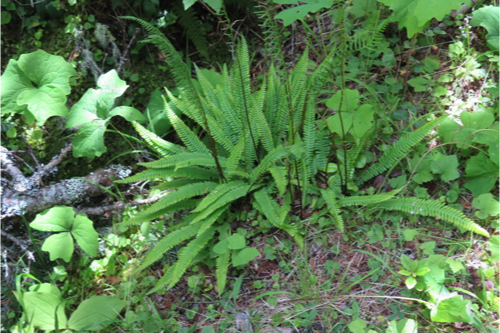
Found in North America from Alaska to California mostly west of the Cascade and Coastal Ranges, and from SE British Columbia into southern Idaho, deer fern is a circumpolar species, growing to about 3 feet in height and 2 feet in width from short rhizomes. In moist shady habitats it can be recognized by its relative size and by its distinctive form having two types of fronds: an evergreen basal rosette of sterile fronds which in winter lie mostly flat against the ground, and a group of fertile fronds that rise vertically out of the center of the basal clump. Sword fern, a common companion in moist understory, is much larger at maturity and has only one type of frond which is fertile. The sterile fronds of deer fern are specialized for photosynthesis, having 35 to 70 pairs of bright green leaflets (pinnae) that are fully attached to the frond stem at their bases, each about ¼ inch wide and up to 2 inches in length. Its fertile fronds have narrower, less dense pinnae along each darker-colored stem and produce two rows of sori on their undersides. Spores inside the sori mature from June to August. After the spores disperse the fertile fronds die back for winter.
Ferns are more ancient terrestrial plants than the conifers (gymnosperms) and the flowering plants (angiosperms), differing from them in that they do not reproduce directly from seeds. Instead, a mature spore can, under moist shady conditions, first grow into a tiny intermediate form called a gametophyte, which can then produce both sperm and egg cells. Again, under the right moisture and temperature regimes, a sperm cell can unite with an egg cell becoming a fertilized egg or zygote. This stage, called a sporophyte, can now develop into a mature plant which we recognize as a fern. This fascinating life cycle is depicted here and in this video.
Though currently known to be host to the larvae of only a few moth species and other insects such as sawflies, deer fern is an important constituent of healthy forest floor microhabitats, creating moist shelter under its fronds for insects, amphibians, small birds, and other animals. Birds have been known to use the fronds for nesting material. Though chemicals in these plants can be mildly toxic when eaten in large quantities, which usually discourages browsing (even by rabbits!), deer fern can be a critical food source for deer, moose, bighorn sheep, mountain goats and elk in winter when other forage is scarce.
Indigenous peoples used all parts of this plant as food, but mostly in emergencies, and usually cooked to neutralize its toxicity from thianamines. Leaves were chewed as treatment for cancer, lung problems, and stomach disorders, and a decoction was made to relieve diarrhea. Fronds were also applied to skin sores. On long journeys leaves were chewed to alleviate thirst. See this site for ethnobotanical references.
In historic times, vast blankets of deer fern were known to have grown in the understory of huge red cedars in Washington's coastal rainforests, both linked to a specific type of micorrhizae that facilitated the exchange of nutrients and sugars among plants, fungi, and soil. These symbiotic associations are especially important in rainforests and other habitats where soils are poor in critical elements such as phosphorous or sulfur. Check out this article for more details on how plant roots and fungi work together below the ground.
This elegant fern is a "must have" for any western Washington garden, adding beauty plus structural diversity in various settings. Though its preferred placement is in moist partial shade in humus-rich acidic soil (pH 3.5 to 6.5) with good drainage, it can tolerate highly acidic to neutral pH, heavy clay to light sandy soils, mossy and boggy areas, and deep shade to morning sun exposures. Deer fern has good winter hardiness, is fairly disease and pest free, and is somewhat drought tolerant in partial shade once established. It does not tolerate full sun. Mulching with fallen leaves is recommended to preserve soil moisture and provide necessary nutrients through their slow decomposition.
In the landscape deer fern is beautiful nestled among rocks, beside logs, along pathway borders, along streambanks, and at pond edges. It is a natural in wooded areas among other native understory plants such as vine maple, rhododendron, evergreen and/or red huckleberry, red-flowering currant, sword fern, trillium, vanilla leaf, and bleeding heart, just to name a few. Deer fern will thrive under red cedar or Douglas fir where other plants may struggle in the acidic environment. It is stunning planted densely as a ground cover - space ferns about 2 feet apart - being a wonderful substitute for harmful invasives such as English ivy, yellow archangel, or vinca (periwinkle).
Propagating deer ferns from spores can result in many new plants within about a year's time but does require frequent monitoring and patience, as shown in this video and in another here. A faster method that produces fewer new plants is by division of healthy 2 to 5 year old ferns in early spring, just as new shoots are beginning to grow. Follow these instructions to easily divide, plant, and enjoy new deer ferns. Or share with your neighbors - there's always a spot for a deer fern!
Always remember, "YOU are nature's best hope!" - Doug Tallamy, author of "Nature's Best Hope", "Bringing Nature Home", and "How Can I Help? Saving Nature with Your Yard".
Marilee Henry is a Kirkland Community Wildlife Habitat Team Member, Washington Native Plant Society (WNPS) Native Plant Steward, Green Kirkland Steward, Finn Hill Neighborhood Alliance Contributor
King Conservation District Fall Bareroot Native Plant Sale
Online plant list preview 11/4/25
Online orders 11/18/25 9am - 2/6/26 noon
Plant Pickups 2/25-28/26 see website for details
SER-UW Native Plant Nursery Sale
In-person sale at UW Center for Urban Horticulture (CUH) 11/9/2025
Washington Native Plant Society
Native Plant and Seed Sources