by Marilee Henry
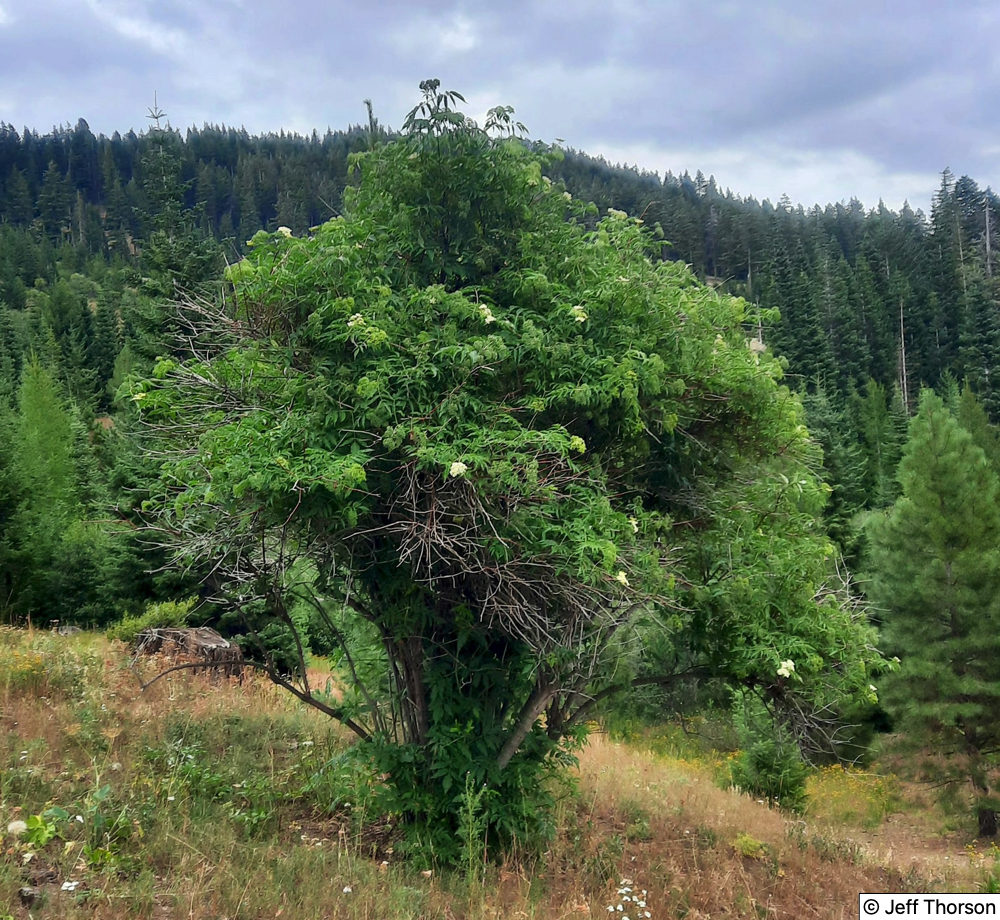
Sambucus, the genus containing elderberries (also called elder), is a globally ranging complex group with occurrences in most temperate and sub-tropical areas. Current accepted scientific names for our region's three natives are coast red elderberry (Sambucus racemosa var. arborescens), black elderberry (S. racemosa var. melanocarpa), and blue elderberry (S. cerulea).
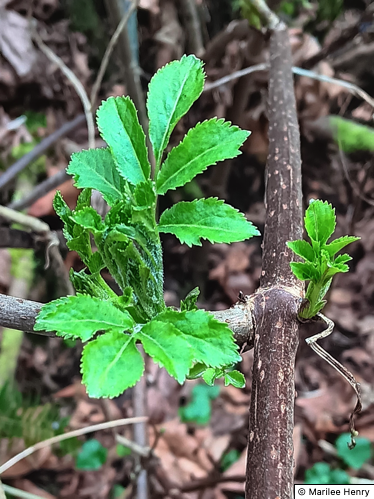
Elderberries (Sambucus species) are perennial deciduous shrubs to small trees, growing to between 10 to 30 feet depending on species. All have opposite compound leaves up to 12 inches in length with 3 to 9 lance-shaped leaflets, each about 6 inches long with shallowly-toothed edges. Plants are typically multi-stemmed, with an arching vase-like form. Stout branches and stems frequently show raised lenticels (pores) and lengthwise texturing in maroon to grayish-brown bark, and ring scars around stems at nodes. Except for newest growth, stems are filled with a soft pith. Numerous small (~1/4 inch wide) fragrant white-to-cream-colored, 5-petaled flowers occur in clusters from early to late spring, ripening into berries from July into September, depending on species/variety.
Elderberries worldwide have a long history as a source for food and medicines. Their berries and flowers are well known in making wines, liqueurs, jellies, jams, syrups, and pies. Today elderberry products are being developed for natural medicines and for fighting cancer. WARNING: Elderberries contain cyanic compounds, especially in their leaves, stems, roots, seeds, and unripe berries that are toxic to humans in varying degrees. When eaten raw, any part of the plant could cause intestinal upset. Proper cooking neutralizes the toxicity as explained here.
All of our native elderberries are wonderful wildlife plants. According to the National Wildlife Federation, they are a host plant to 36 species of moth and butterfly larvae in our region. Their fragrant blooms contain nectar and nutritious pollen, attracting many pollinators. Large flower clusters provide wide landing areas for beetles. They produce masses of small berries that are eagerly eaten by many birds and mammals including bears and raccoons. These copious amounts of fruit, high nutrients, are important summer wildlife food sources. Though the foliage is not usually browsed during the growing season, in late fall it can become more palatable to deer and elk. In winter the bark and buds might be eaten. Dead stem ends are easily excavated by various native bees and other insects for winter nesting sites. Fast growing and densely branched, elderberries provide excellent cover and nesting spaces for birds, and shade for fish when planted along streambanks.
Sambucus racemosa has two varieties native to Washington. They both can be identified by their pyramidal flower and berry clusters, as opposed to the flat-topped clusters of other species. The small flowers usually have reflexed petals. The two varieties are:
Coast red elderberry (S. racemosa var. arborescens) occurs mostly on the west side of the Cascades in Washington. Its preferred habitats are moist shade or forests, riparian zones, and coastal areas. It is among the first blooming shrubs in western Washington, developing flowers and leaves as early as March. It grows to about 20 feet in height and has bright red (rarely yellow) pyramidal berry clusters which ripen in June to August. WARNING: red elderberry is considered to have higher levels of cyanic compounds than plants with blue/black berries. Before using the red berries, even in cooked recipes, it is recommended to remove the seeds and stems first.
Black elderberry (S. racemosa var. melanocarpa) occurs in Washington more frequently east of the Cascades, in a variety of habitats that include drier sunnier areas than for red elderberry. It typically grows to about 10 feet in height, blossoming slightly later around April, and has shiny purplish-black pyramidal berry clusters ripening July to August.
Blue elderberry (S. cerulea) is widely distributed on both sides of the Cascades in Washington. It blooms from May to July in large flat-topped clusters that may measure up to 10 inches across. This native can reach 30 ft in height, though it typically grows in a shrubbier form under 10 feet tall. It prefers moist but sunnier more open locations along roadbeds, streambanks, riparian zones, canyon bottoms, and moist to dry open forests. Its blue-black berries are covered in a glaucous bloom that render them powder blue. They ripen in August to September/October.
All three native elderberries do well in Puget Trough urban gardens, benefiting wildlife while providing stunning ornamental value during flowering and fruiting. Their fast-growing densely branching characteristics make them perfect for forming hedges and barriers. Their extensive roots help stabilize soils and reduce erosion on slopes. They prefer nutrient-rich, moist but well-drained, slightly acidic soils. Red elderberry can tolerate a range of light exposure including shade, making it versatile in areas such as raingardens, bioswales, moist woodlands, ditches, and along shady fence lines. Blue and black elderberry prefer full sun to partial shade and will grow in rocky or sandy soils to heavy clay. All tolerate pruning to fit desired spaces.
Be sure to leave pruned stems in the garden as they may be sheltering nesting mason bees and other beneficial insects!
Always remember, YOU are nature's best hope! - Doug Tallamy, author of "Nature's Best Hope", "Bringing Nature Home", and "How Can I Help? Saving Nature with Your Yard".
Marilee Henry is a Kirkland Community Wildlife Habitat Team Member, Washington Native Plant Society (WNPS) Native Plant Steward, Green Kirkland Steward, Finn Hill Neighborhood Alliance Contributor
Marilee can be contacted at kirklandhabitat@gmail.com.
Spring 2026 Native Plant Events/Information:
Snohomish Conservation District Native Plant Sale
Walk-up Sale and Pre-Ordered Plant Pickups
March 7 @ 9am - 4pm
March 8 @ 9am - 1pm
King Conservation District: All About Pollinators Webinar - free
March 18, 6:00PM - 7:30PM
SER-UW Spring Plant Sale
April 6 @ 9am to April 10 @ 5pm: Online Ordering
April 19 @ 10am - 2pm: In Person Sale
see SER-UW link for details
Washington Native Plant Society Spring Plant Sale
April 25, Bellevue Botanical Garden 10am
see WNPS link for details
Arboretum Foundation Spring Plant Sale
April 26, UW Arboretum, Graham Visitors Center
see Arboretum link for details
Kingsgate Library Lecture
Landscaping with Native Plants
Thursday, April 30, @ 10:30am -- noon
Washington Native Plant Society:
Native Plant and Seed Sources