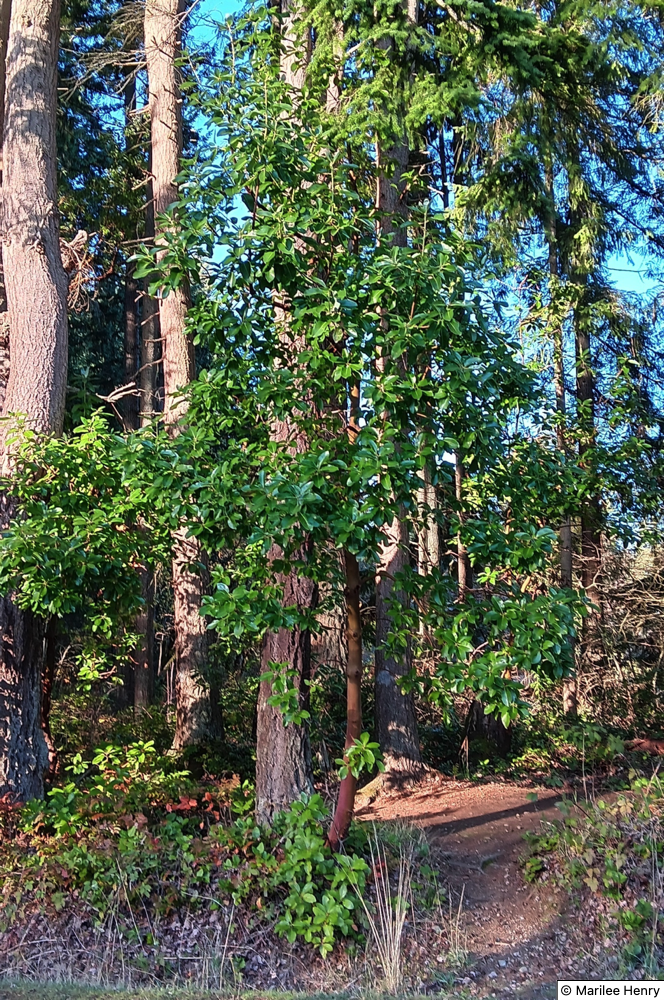
by Marilee Henry
So rhapsodized the famous storyteller Bret Harte in the late 1800's on the special beauty of Pacific madrone (also pronounced "madrona" or "madrono") through the various seasons. And indeed, this native, though sometimes difficult to grow, is spectacular for landscaping effects as well as for benefiting the environment and wildlife.
Pacific madrone ranges from coastal British Columbia to southern California and Baja, with isolated pockets in the Sierra Nevada foothills. It is the only broadleaf evergreen tree native to Canada, and one of only two in Washington (the golden chinquapin is the other) where it grows west of the Cascade Crest from sea level to about 3,000 feet, mostly along the coast, in the Puget Trough, and in western parts of the Columbia River Gorge.
Pacific madrones are recognized by their alternate ovate to elliptical evergreen leaves that are 3 to 6 inches in length with shiny top surfaces and duller green undersides, by their rounded canopies, and by their distinctive orange-tinted chartreuse trunks and branches overlain by thin peeling cinnamon-colored bark which is shed during the summer. Madrones can be frequently spotted on coastal bluffs or in rocky terrains at the edges or openings in mixed Douglas fir and hemlock or oak forests, as tall straight stately trees over 100 feet in height, or as having beautifully curved, twisted trunks and limbs, especially at exposed sites.
In April to May, these trees produce copious terminal compound clusters of creamy white (sometimes pinkish) urn-shaped flowers, each bloom about ¼ inch in length, whose fragrance attracts many pollinators including hummingbirds, bees, flies, and butterflies, especially Celastrina ladon, the spring azure butterfly. Bumblebees and other insects that employ buzz pollination are most efficient at releasing the tightly held pollen from tiny pores in the anthers, as is common for many other species in the heather family (Ericaceae) such as blueberries, huckleberries, and rhododendrons.
Ripening in late autumn through December, clusters of dull reddish-orange knobby-surfaced fruits, each about 0.4 inches in diameter, provide feasts for many birds and wildlife, including American robins, cedar waxwings, varied thrushes, band-tailed pigeons, quail, woodpeckers, deer, bears, foxes, coyotes, raccoons, ringtails, and others. This late-season food source is crucial for many species as winter scarcity sets in. Young madrone shoots are also an important winter browse for ungulates, though mature leaves are considered deer resistant. The brittle limbs of this species may break off during prolonged freezes or high winds, eventually creating cozy spaces for cavity-nesting owls, woodpeckers, and small animals.
Besides that of the spring azure butterfly, Pacific madrone is host to over 40 other species of moth and/or butterfly larvae. Here are a few more examples for budding lepidopterists: the Columbian emerald moth, the silver-spotted tiger moth, and the polyphemus moth. All moth and butterfly larvae are essential food for many birds in raising their chicks. These larvae are usually specialists, requiring specific native plants with which they have evolved for their survival, and ultimately for stable bird populations. (Note that butterfly bush does not host any larvae of PNW native moths or butterflies!)
Native Americans used madrone for many purposes. Its dense hard wood produced long-lasting high temperature fires for cooking, heating, and making charcoal (though some tribes in B.C. believed madrone to be sacred, having provided anchorage to the world for their canoes during the deluge, and forbade burning it.) The wood was also used for furniture, and was carved into pipes, spoons, and other small objects and utensils. Because the tree tends to grow in twisted and curved forms, has low decay resistance, and dries unevenly, it is not used for general construction. However, it is highly prized for veneers.
Indigenous peoples also used madrone bark for medicinal teas, for tanning agents to preserve skins, fishhooks and canoe paddles, and for making brown dyes. Berries were eaten raw in small quantities or dried, made into cider, and fashioned into jewelry, decorations, or used as fish bait. Leaves were chewed or brewed into teas for treating burns and other ailments.
Pacific madrone is a highly desirable landscaping ornamental as well as being important for restoration projects. Madrone should be planted when small --1 foot or less in height -- as it quickly develops a massive root system that, though great for stabilizing bluffs and slopes, makes the tree very sensitive to being disturbed or transplanted as it ages. Ideal sites are on south or west-facing slopes in rocky/sandy mineral soils with very good drainage, though trees can be planted in a clayey environment if they will not be water-logged. Young plants prefer partial shade, but need to be able to reach full sun at maturity. They are tolerant of acidic conditions, as their root systems form symbiotic relationships with special ericoid mycorrhizae that allow uptake of necessary organic compounds in soils low in nitrogen and phosphate. Madrones should be placed away from other plants needing frequent watering. Protect young trees from browsing and give them supplemental water during their first three summers. Once established, water deeply only occasionally during droughts.
Though its above-ground parts have low fire resistance due to its thin bark, this species is dependent on periodic fire in natural settings to reduce forest canopies that would otherwise shade out mature trees. After a fire, new shoots can grow from the undamaged underground burl, a large woody structure at the base of the trunk containing dormant buds. Fires also promote seed germination on newly exposed mineral soil. Unfortunately, poor forest management practices that increase fire-return intervals have contributed to decline in wild madrone populations, along with other factors of habitat loss due to human development, invasive species, and global warming.
Though easily grown from seed, young Pacific madrones are sometimes difficult to find at nurseries or plant sales.
NOTE: A limited number of free young seedlings will be available at the Finn Hill Free Little Plant Stand located at 8410 NE 144th St, Kirkland, starting Sunday January 4th.. The seedlings should be planted within the month so they can establish deep roots before spring.
Let's grow more of these beautiful trees in our neighborhoods. Pacific madrone is a perfect native replacement for invasive English holly!
Always remember, YOU are nature's best hope! - Doug Tallamy, author of "Nature's Best Hope", "Bringing Nature Home", and "How Can I Help? Saving Nature with Your Yard".
Marilee Henry is a Kirkland Community Wildlife Habitat Team Member, Washington Native Plant Society (WNPS) Native Plant Steward, Green Kirkland Steward, Finn Hill Neighborhood Alliance Contributor
January 2026 Native Plant Events/Information:
Snohomish Conservation District Native Plant Sale
Online orders 01/06/26 9am - 02/16/26 4:30pm
Plant Pickups March 7 & 8 - see SCD link for details
King Conservation District Bareroot Plant Sale
Online orders now through 02/06/2026 noon
Plant Pickups 02/25/2026 - 02/28/2026 see KCD link for details
Washington Native Plant Society:
Native Plant and Seed Sources