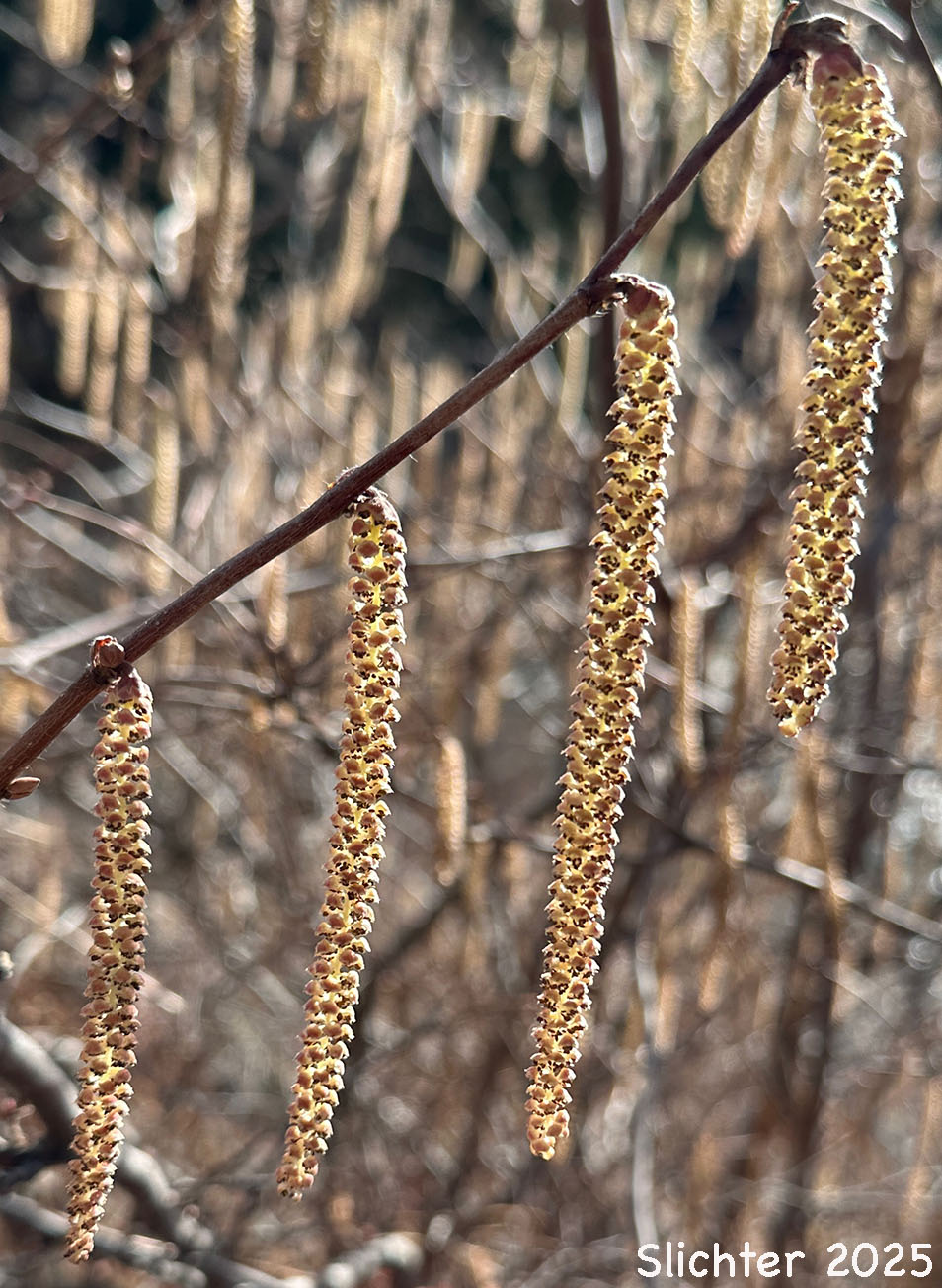
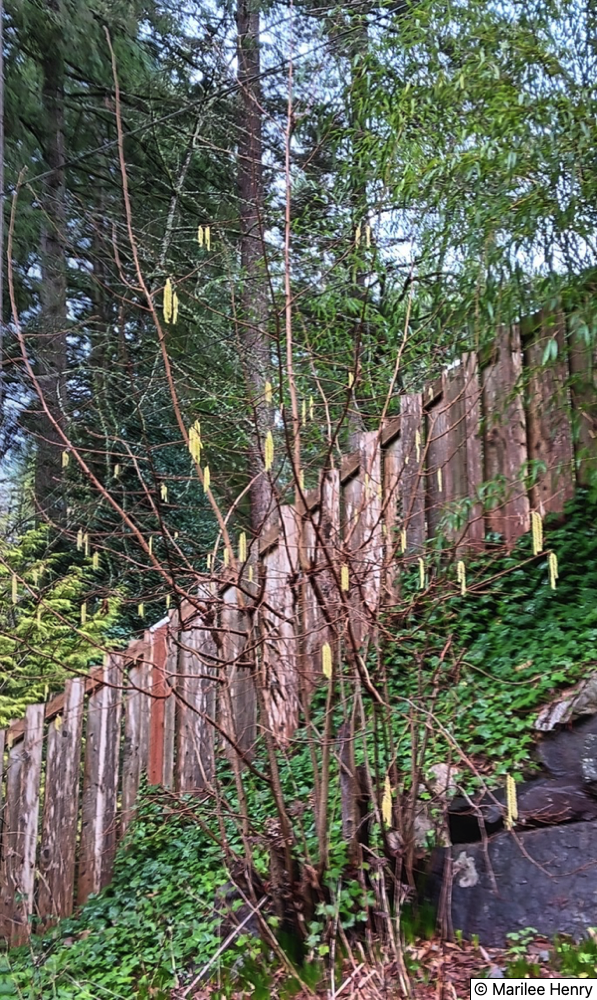
 Lake Forest Park garden, WA. |
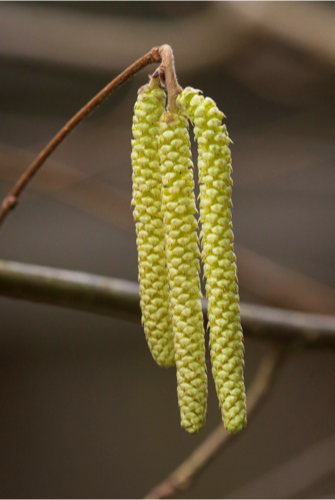 off the tips of leafless branches. realgardensgrownatives.com |
by Marilee Henry
|
Lake Forest Park garden, WA. |
off the tips of leafless branches. realgardensgrownatives.com |
Our focus plant this month, California hazelnut, is both very beneficial to wildlife and a valuable ornamental addition to any western Washington urban garden. This monoecious (having male and female flowers on the same plant) perennial shrub/small tree can reach 15-20 feet in height with a maximum spread of ~20 feet at maturity. Multiple stems arch in a vaselike form while thin younger twigs grow in a zig-zaggy pattern. It is a common understory plant in the mixed conifer-hardwood forests of western Washington that can be recognized in late winter/early spring by its separate male and female blooms. Yellow-brown dangling 2- to 3-inch catkins contain the staminate (male) flowers and clusters of tiny pistillate (female) flowers display bright red stigmas; both are located along branch ends and nodes. Flowers mature before leaves fully emerge in March. Hazelnut flowers have evolved to efficiently use the wind as the shrub's primary method of pollination while also decreasing self-pollination.
California hazelnut leaves are alternate, on ~ 0.5 inch petioles (leaf stems), growing 1.5 to 4 inches in length. They are elliptical to ovate in shape with doubly serrated edges, pointed tips, and paler green undersides. Foliage on first year branches is velvety hairy, and glandular hairs are usually present on new twigs. Clusters of one to three hard-shelled nuts, each completely encased in a prickly-hairy beaked husk, form on branches two years and older in July and August.
The benefits to wildlife from hazelnut shrubs are numerous. Their ability to form dense thickets creates shelter for many birds, and small mammals. Their leaves are food for deer, beaver, rabbits, and livestock. Their nuts are prize food for jays, woodpeckers, deer, squirrels, bears, and others; and in turn are critical for the spread and survival of hazelnut populations through caching. Watch this marvelous video to see jays' caching in action!
According to the National Wildlife Federation, 84 species of moths and butterflies are known to use hazelnut as a host plant, including the funerary dagger (Acronicta funeralis), the blinded sphinx (Paonias excaecata), and the pale beauty (Capaea perlata) moths. The larvae of these moths and butterflies are a vital food source for many birds in raising their young. Pollen produced in late winter is an important food source for early emerging native bees who feed it to their young.
American indigenous peoples have cultivated our native species for over 7,000 years, employing fire and coppicing methods (cutting shrubs to the ground) every 5 to 7 years to maximize their growth and nut yields. The sweet edible nuts were roasted or eaten raw, or pounded into cakes and mixed with berries, meats or fats, and used as trading items.
Hazelnut is considered a pioneer species for restoration purposes, being among the first of woody plants to colonize disturbed open areas.
In landscaping, hazelnut is a wonderful choice for pollinator gardens, woodland areas, and food forests. Dense plantings can create privacy barriers, hedgerows, windbreaks, and erosion control on slopes. Golden-yellow leaves in autumn followed by pale-yellow dangling catkins in winter give hazelnut high ornamental value.
Hazelnut is hardy to 0°F and easy to grow. It prefers a site in partial sun in moist, well-drained, slightly acidic soil, but it will tolerate full sun to heavy shade, clay (if it is not water-logged), and slightly alkaline soils.
Nut production is best in sunnier exposures and requires cross-pollination. Placing at least 3 genetically different plants (grown from seed, not clones of one another!) within 50 feet of each other will enhance yields - and keep the wildlife happy! Top dress the plants with organic compost and arborists woodchips for needed nutrients and moisture retention.
New plants will need supplemental watering during dry conditions for the first 2 or 3 years until well established.
Propagation of California hazelnut is best done by seed, but collection must be done while husks are still a bit green to beat the squirrels and jays! (See this video for tips on harvesting native hazelnuts.)
Corylus cornuta ssp. californica is usually available in native plant nurseries and at local native plant sales.
Let's get more of this versatile shrub in our gardens and enjoy its delicious harvest!
Always remember, YOU are nature's best hope! - Doug Tallamy, author of "Nature's Best Hope", "Bringing Nature Home", and "How Can I Help? Saving Nature with Your Yard".
Marilee Henry is a Kirkland Community Wildlife Habitat Team Member, Washington Native Plant Society (WNPS) Native Plant Steward, Green Kirkland Steward, Finn Hill Neighborhood Alliance Contributor
Marilee can be contacted at kirklandhabitat@gmail.com.
February 2026 Native Plant Events/Information:
Snohomish Conservation District Native Plant Sale
Online orders 01/06/26 9am - 02/16/26 4:30pm
Plant Pickups March 7 & 8 - see SCD link for details
King Conservation District Bareroot Plant Sale
Online orders now through 02/06/2026 noon
Plant Pickups 02/25/2026 - 02/28/2026 see KCD link for details
Treat yourself by visiting Go Natives! Nursery in Shoreline.
https://gonativesnursery.com/
Mondays through Saturdays 10am - 4pm. Sundays 10am - 4pm
Washington Native Plant Society:
Native Plant and Seed Sources