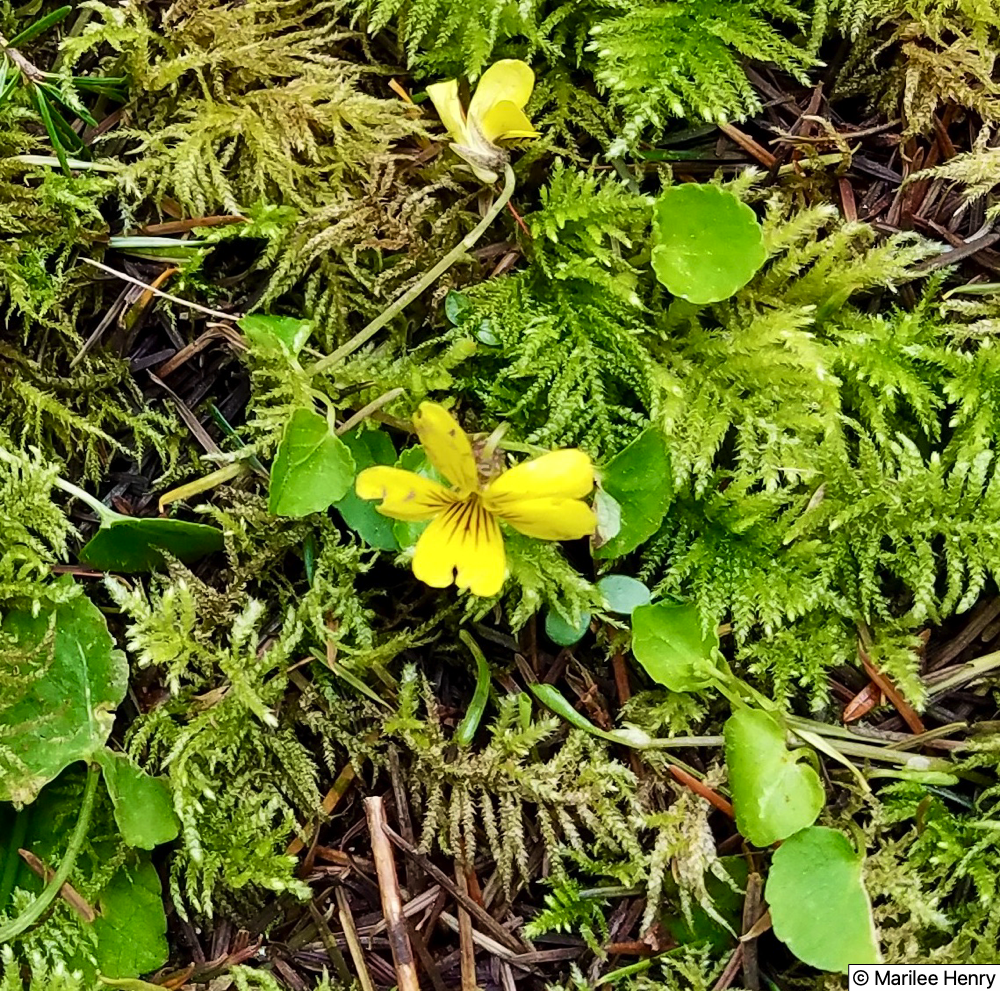
by Marilee Henry
We are fortunate to have many native species of violets that grow in most major habitats across our state, in colors of white, yellow, and/or blue to violet, from sea level to subalpine elevations. A number of these species can be grown in local urban gardens in varied niches. (For photos, ranges and habitats of various violets, see Turner Photographics page and/or the Burke Image Collection.)
My favorite woodland species is evergreen violet, Viola sempervirens, which occurs in western Washington from the coast to mid elevations of the Cascades and in parts of the Columbia River Gorge. As early as March, its delicate yellow flowers may be spotted in moist forest understories, openings and edges, or on mossy slopes, heralding the onset of spring. Also known by the name of redwood violet, this species ranges from SE Alaska through British Columbia and western Washington to California, as much at home among giant redwoods as in moist shady mixed conifer forests further north.
Evergreen violet is a low, almost prostrate perennial, spreading both by stolons (horizontal stems growing above or just below ground) and by rhizomes (under-ground horizontal stems), and is capable of forming mats in the forest understory. It typically grows no taller than 6 inches in height, with five pale yellow to gold-colored flower petals, the lower three with brownish-purple veins acting as nectar guides to attract pollinating bumblebees, bees, and flies. Blooming period is from March to June. The dark green leaves, which persist through the winter, are small (~1 inch in width), thick and leathery, slightly heart-shaped (cordate-ovate) with gently scalloped (crenate) edges and small purplish blotches mostly on their undersides. The leaf stems (petioles) are typically up to 4 inches in length, with the flowers on stems rising above them. Both leaf and flower stems grow along most of the aerial plant stem's length.
Seeds are produced in late summer to early fall from 3-valved, purple-mottled capsules that, as they dry after opening, shrink to the point where the seeds pop out explosively (explosive dehiscence), helping to disperse them up to 9 feet from the parent plant. (This video shows some examples of "exploding" seed pods.) The little brown seeds each have attached a nutritious package called an elaiosome that attract ants; they carry them to their nests where the elaiosome is consumed by their larvae and the seed is left in their fertile "garbage" dumps to germinate, thereby increasing dispersal distances and propagation success. Seed dispersal by ants is called myrmecochory.
There are two other yellow violets in western Washington whose ranges can overlap with that of evergreen violet: stream violet (V. glabella) and round-leaved violet (V. orbiculata). Both have flowers that resemble those of evergreen violet, but stream violet can be found in moister riparian habitats as well as in moist conifer forest understories, it grows to taller heights (up to 12 inches), has larger, thinner, more heart-shaped leaves with pointed tips that do not persist over winter, and their leaf and flower stems are located at the ends of the plant stems. Round-leaved violet is more similar to evergreen violet but is a smaller plant, typically reaching up to only 3 inches in height with rounder thinner leaves that rarely persist through winter. It may overlap evergreen violet's range at moist forest edges at mid elevations but can also be found up to subalpine levels and in more open habitats such as moist meadows and slopes, flowering later in May through July. Both yellow violets can be distinguished from evergreen violet in that they do not have leathery evergreen leaves with purplish mottling, and they do not produce stolons.
An interesting fact about many of Washington's native violets, including the three above species, is that they actually produce two different types of flowers. Besides their showy open (chasmogamous) flowers that attract insect pollinators, they also produce inconspicuous closed (cleistogamous) flowers later in the blooming season that are hidden under the foliage near the soil surface. These flowers self-pollinate, take fewer resources for the plant to create, and help ensure reproductive success, a benefit especially in unfavorable environmental conditions even though they do not increase diversity.
Evergreen violet is highly beneficial to wildlife, being an early nectar and pollen source for a wide range of pollinators including emerging queen bumblebees, sweat bees, and flower flies. Its evergreen foliage provides shelter for small fauna, especially in winter. It is a host plant for a number of butterfly and moth larvae, including the rare Puget Sound Fritillary (Argynnis cybele pugetensis), Hydaspe Fritillary (Argynnis hydaspe), and Pacific Fritillary (Boloria epithore). Collectively, species of the Viola genus are the host plants for the entire family of Fritillary butterflies, and according to the National Wildlife Federation, host at least 27 species of moth/butterfly larvae in our region. Various birds and mammals eat violet seeds.
The blossoms and leaves of native Viola species are edible and have been eaten raw or cooked historically by indigenous peoples and currently in salads, as teas, and as candied decorations. The flowers can be made into jams, jellies, and syrups. The leaves are full of vitamins A and C. Lower Elwha Klallam peoples are said to have mashed viola flowers into a poultice to soothe bruises and sores. The leaves contain salicylic acid, which can reduce pain and swelling. Other historical medical uses can be found here. WARNING: Some sources recommend avoiding eating violet seeds, roots, or pods. Consuming large quantities of flowers and/or leaves at one time may cause gastric discomfort.
Propagation by seed is easy for most violets. Just be sure to gather them before the pods open, as they are turning from green to light brown, as they will dry quickly and disperse ballistically! Seeds require 4 to 6 weeks of cold stratification, so planting them in fall is optimal. Rooted plantlets on stolons of evergreen violet can be dug and replanted in fall, as well as separating pieces of rooted rhizomes from the parent plant.
Evergreen violet is a wonderful plant for that shady space under your conifers. As another plus, it is reputed to be deer resistant! Its preferred location is in evenly moist slightly acidic nutrient-rich soil, in bright but indirect sunlight to partial shade. It does not tolerate drought or its opposite, being water-logged. This site suggests using violets to replace your lawn - plant evergreen violets in the moist shady corners and use other species for the sunnier areas!
Always remember, YOU are nature's best hope! - Doug Tallamy, author of "Nature's Best Hope", "Bringing Nature Home", and "How Can I Help? Saving Nature with Your Yard".
Marilee Henry is a Kirkland Community Wildlife Habitat Team Member, Washington Native Plant Society (WNPS) Native Plant Steward, Green Kirkland Steward, Finn Hill Neighborhood Alliance Contributor
Marilee can be contacted at kirklandhabitat@gmail.com.
Spring 2026 Native Plant Events/Information:
SER-UW Spring Plant Sale 2026
April 6 @ 9am to April 10 @ 5pm: Online Ordering
April 19 @ 10am - 2pm: In Person Sale
see SER-UW link for details
Washington Native Plant Society Spring Plant Sale
April 25, 2026 Bellevue Botanical Garden 10am
see WNPS link for details
Arboretum Foundation Spring Plant Sale
April 26, 2026, UW Arboretum, Graham Visitors Center
see Arboretum link for details
Kingsgate Library Presentation with Julie O'Donald
Landscaping with Native Plants
Thursday, April 30, 2026 10:30am-noon
Washington Native Plant Society:
Native Plant and Seed Sources